ultimate-guide
Insulated Garden Office for Year-Round Use: Complete Guide
Adrian Bennett · 1 November 2026
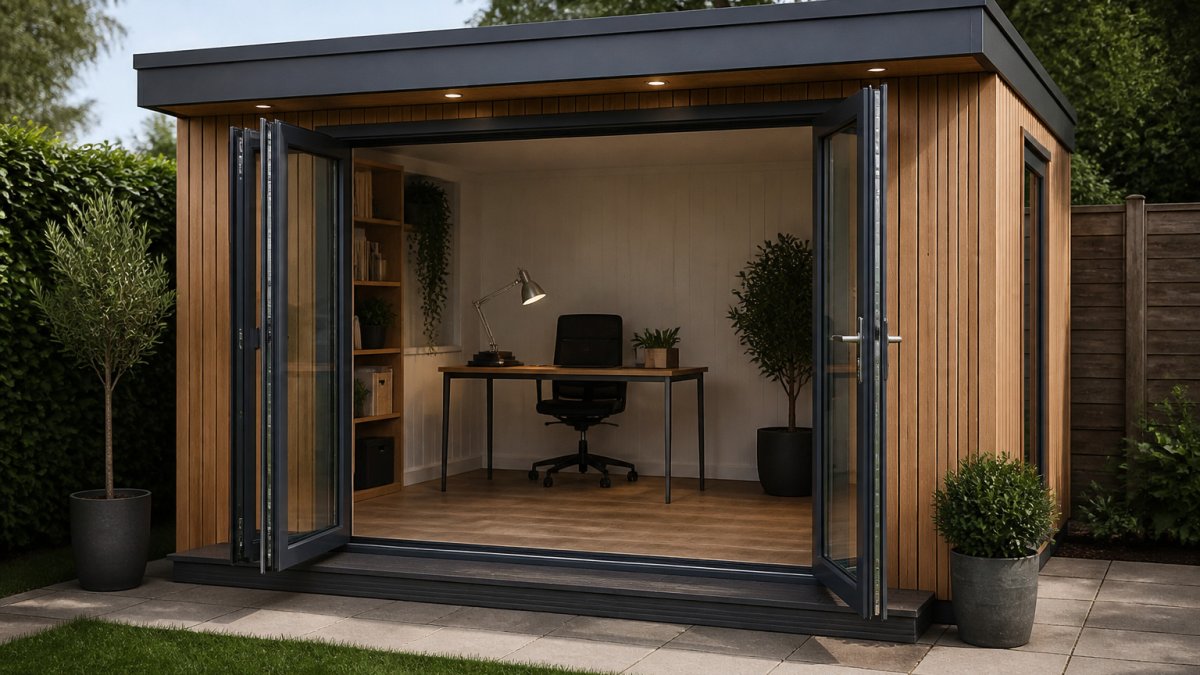
Quick Summary
An insulated garden office suits year-round use when its walls, floor and roof are all insulated, its windows are double glazed, and it has ventilation to stop condensation. Insulation in only one element leaves cold spots, so the whole envelope needs treating. Wall insulation of 44 mm is described as a realistic minimum for winter use.
- Insulate walls, floor and roof together, since heat escapes through every surface.
- Specify 44 mm wall insulation as a starting point, provided the roof and floor are also insulated.
- Use double-glazed windows with a thermally efficient frame, as windows are the weakest thermal point.
- Plan ventilation from the start, using trickle vents or an extractor to prevent condensation.
- Ask for a heat-loss calculation in watts before choosing a heater to size it correctly.
Table of Contents
- What Makes a Garden Office Suitable for Year-Round Use
- Garden Office Insulation: Walls, Floors, Roof and Thermal Bridging
- Why Insulating the Whole Envelope Matters
- Glazing and Doors: Double Glazing and House-Quality Specification
- Garden Office Heating Options for Winter Comfort
- Garden Office Ventilation and Condensation Control
- Realistic Garden Office Running Costs and Energy Use
- Foundations, Planning and Building Regulations to Check First
- Climate, Seasonal Performance and Build Quality Over the Long Term
- Buying Checklist and Specification Comparison Before You Commit
- Frequently Asked Questions
What Makes a Garden Office Suitable for Year-Round Use
A garden office is suitable for year-round use when its envelope keeps heat in, resists damp, and holds a steady temperature through a British winter. Fully insulated garden buildings for this purpose are listed from around £9,799, a figure that reflects the extra specification rather than a basic shed Greenhouse Stores garden room price listings.
Many people assume that any garden building can double as an office. In practice, most of them are not built for daily use through December and January.
Year-round suitability rests on several things working together. The walls, floor and roof need insulation. The windows and doors need to seal properly. The building needs ventilation so moisture can escape, and it needs a heat source that can hold the room at a working temperature.
Suppliers now describe the insulated garden room as a space for year-round use, usually pairing insulation with double glazing and heating as standard Green Retreats garden room specification. That framing is useful because it shows buyers what to look for: a complete specification, not a single upgrade.
Before you commit, decide how you will use the space. A room for occasional evening work needs less than one for full-time home working through the winter. The more hours you spend in it, the more the specification matters.
Garden Office Insulation: Walls, Floors, Roof and Thermal Bridging
Garden office insulation works best when every element of the building envelope is treated, not just the walls. Heat escapes through the floor and roof as readily as through the wall panels, so a thick wall insulation alone leaves gaps in the performance.
Suppliers commonly quote wall insulation in the range of 44 to 70 mm Satus Baltic garden office buyers guide.
Thermal bridging is the detail most buyers overlook. It occurs where a material conducts heat around the insulation, typically at joints, corners, window frames and where timber studs run through the insulated layer.
The floor deserves particular attention because it sits on the ground, which holds a lot of cold. A raised timber floor with insulation between the joists, or a suitably insulated base, reduces the chill that rises through the boards.
Ask any supplier for the U-value of each element, or at least confirm the insulation thickness and type for walls, floor and roof separately.
Why Insulating the Whole Envelope Matters
Insulating the whole envelope matters because heat loss is cumulative. The building loses warmth through every surface, and the weakest surface sets the pace for the whole room. A well-insulated wall with an uninsulated roof will still struggle to hold temperature.
Think of the envelope as a system. The walls, roof, floor, windows and doors form one continuous barrier between the warm interior and the cold outside. If one part is poor, the heater has to work harder to compensate, and running costs rise.
This is why supplier guidance increasingly links year-round use to insulation in the walls, roof and floor together, plus double-glazed windows Satus Baltic specification guide.
Be sensible about the trade-off. Full insulation adds cost, and some buyers may not need it for seasonal use. The choice as whether partial or full insulation is worth the extra money, weighing price, materials and intended use Garden Buildings Direct insulation comparison.
Glazing and Doors: Double Glazing and House-Quality Specification
Double glazing is the standard expected for a year-round garden office, because windows are the weakest thermal point in most timber buildings.
Look for double-glazed units with a sealed, insulated frame. The frame matters as much as the glass. A poor frame conducts heat and creates a cold edge around the window, so ask whether the frame is thermally broken or insulated.
Doors need the same attention. A solid, well-fitted door with good seals keeps draughts out. Ask for multi-point locking and weather strips on all sides. Check the threshold too, since a gap at the base is a common source of cold air.
A house-quality specification means the doors and windows meet the standard you would expect from a home rather than a garden building.
Glazing area is also a trade-off. Large panes of glass bring light and a pleasant outlook, but each square metre of glass loses more heat than the same area of insulated wall.
Garden Office Heating Options for Winter Comfort
Heating a garden office is not simply a matter of buying the biggest heater that fits. The right choice depends on the room's heat loss, how quickly you need it warm, how many hours a day you work, and whether you want cooling in summer as well. Get the specification right and a modest heater will hold a comfortable temperature; get it wrong and you will either overspend on equipment or sit in a room that never quite warms up.
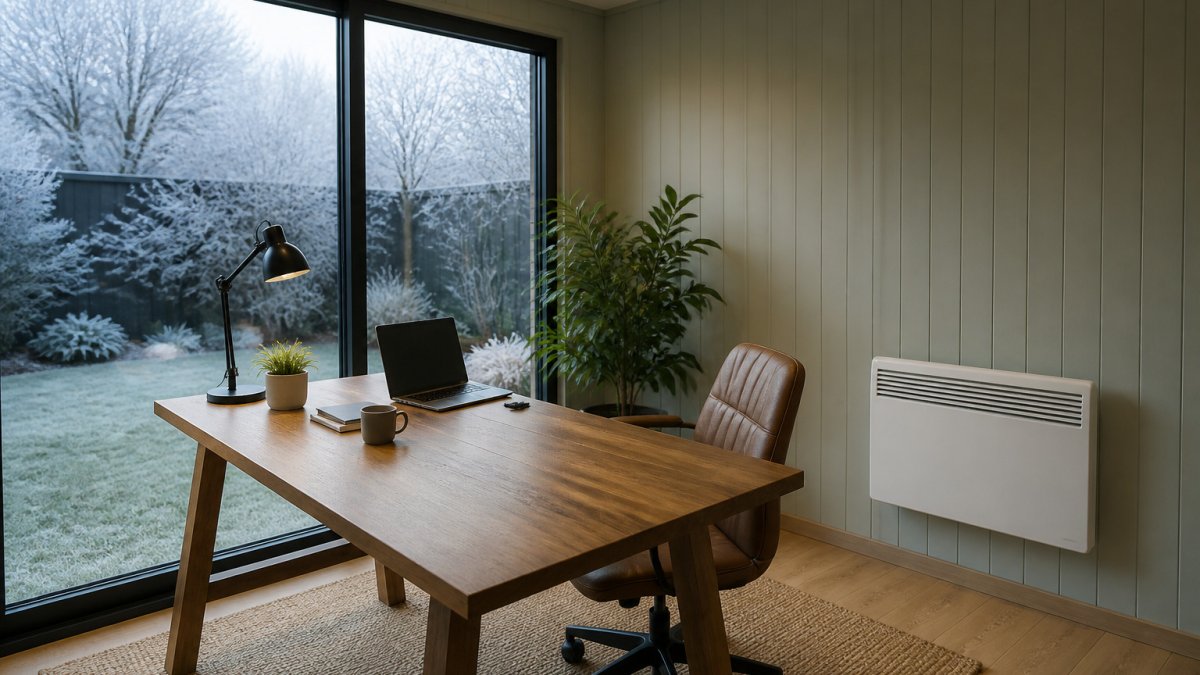
Start by understanding the load. The heating output a garden office needs depends on its size, insulation and glazing, so ask for a heat-loss calculation before choosing a heater. Ask the supplier or installer for a heat-loss calculation rather than guessing, because the number drives every other decision.
Electric heaters: the practical default
Electric panel heaters, wall-mounted convection heaters and fan-assisted heaters are the most common choice in garden buildings because they need no flue, no fuel storage and no gas supply. They are cheap to buy, simple to control and easy to replace.
A thermostatically controlled heater cycles on and off once the room reaches the set temperature, so it does not draw its full rated output continuously. That is why insulation matters more than heater size: a better envelope reduces the proportion of time the element is energised.
Fan heaters warm a room quickly but are noisier and less comfortable for all-day use. Convection panel heaters are silent and give a steadier temperature. For a desk-based working day, a panel heater with a programmable thermostat and a timer is usually the most sensible starting point.
Infrared and radiant panels
Infrared panels heat surfaces and people rather than the air, so they feel effective within seconds of switching on. They suit occasional use and rooms where you want spot warmth over a desk. They are less effective at maintaining a steady background temperature in a cold room, and they do not address condensation risk in the same way as warming the air. Treat them as a supplement or a solution for intermittent use, not a substitute for a properly heated envelope.
Air source heat pumps and split systems
A small air source heat pump or a split air-conditioning unit can heat and cool efficiently, and in a well-insulated room the coefficient of performance means each unit of electricity delivers more than one unit of heat. These systems cost more to buy and install, need a properly sized electrical supply and an outdoor unit with suitable siting and drainage, and are best specified with a heat-loss calculation. For a room used daily throughout the year, the efficiency gain and the summer cooling can justify the higher upfront cost. For occasional use, it rarely does.
Sizing, controls and placement
Match the heater output to the calculated heat loss, not to the room's floor area alone. A heater that is too small will run continuously and never reach temperature; one that is too large will cycle sharply and create uneven warmth. Use a programmable thermostat positioned away from the heater, direct sunlight and draughts, and set a background temperature rather than blasting the room before use. A timer that brings the room up to temperature half an hour before you start work is more efficient than heating it all day.
Plan the electrical supply first
A garden office running a heater, computer, monitor, lighting and perhaps a kettle needs a dedicated circuit sized for the total load, with a cable run from the house that accounts for voltage drop over distance. This work should be carried out by a qualified electrician and is far easier during the build than afterwards. Confirm with the supplier who is responsible for the supply, the consumer unit and the final connection, and get the cable specification in writing.
Whatever system you choose, remember that heating and ventilation work as a pair. A sealed, warm room with no air exchange will become humid, and a humid room feels colder than its thermostat suggests. The next section covers how to manage that balance.
The article compares the main heating approaches for a garden office and what each one means for running and comfort.
| Heating option | Best for | Key difference |
|---|---|---|
| Electric panel heater | Daily use with a stable background temperature | Silent and steady, but every unit of electricity is paid for as heat |
| Fan heater | Warming a room quickly | Fast, but noisier and less comfortable for all-day use |
| Infrared panel | Occasional use and spot warmth over a desk | Heats people and surfaces, not the air; weak for background heating |
| Air source heat pump or split system | Daily use all year, including summer cooling | Higher upfront cost, but more heat per unit of electricity in mild conditions |
Garden Office Ventilation and Condensation Control
Ventilation keeps moisture out of an insulated garden office. A tightly sealed, well-insulated room traps the humidity produced by breathing, cooking and drying clothes, and that moisture condenses on cold surfaces.
Plan ventilation from the start. Trickle vents in the window frames, an extractor fan on an internal wall, or a passive vent in the wall give a controlled exchange of air.
Condensation usually appears first on the coldest surfaces, which are often the corners, window reveals and the lower part of the external wall.
Use the room sensibly as well. Keep a dehumidifier available if the space is used for long hours, avoid drying wet clothes inside, and keep furniture a few centimetres away from external walls so air can circulate.
Ask the supplier how the building is ventilated and where the vents are located. A good specification shows the ventilation as part of the design, not an afterthought added once damp appears.
Realistic Garden Office Running Costs and Energy Use
Most garden office pages quote a purchase price and stop there. The ongoing cost of heating, lighting and powering the room is the number that determines whether the building is genuinely usable year-round, and it is the number buyers most often underestimate. This section sets out a transparent way to estimate it, with the assumptions stated so you can substitute your own tariff and usage.
The three variables that drive the bill
Running cost depends on three things: the heat loss of the building, the efficiency of the heating system, and the hours you actually use the room. Everything else is secondary. A well-insulated office with a thermostatic heater used eight hours a day may cost less to run than a poorly insulated one used for two hours, because the poorly insulated room never reaches a stable temperature and the heater runs flat out whenever it is on.
A worked estimate
Take a well-insulated garden office of around 10 to 12 square metres with a full envelope and double glazing, heated by a 1.5 kW thermostatic panel heater. On a cold winter day the heater might run at an average duty cycle of around 40 per cent over an eight-hour working day. That gives roughly 4.8 kWh of electricity for heating.
Daily and monthly running costs depend on your electricity tariff and how many hours the room is used. In milder months the heating duty cycle falls sharply, and in summer it drops to near zero, so the annual figure is well below twelve times the winter month. Annual running costs depend on your tariff, hours of use and habits, so please request a quote for current figures.
These figures are illustrative, not a quote. Substitute your own unit rate, your own hours and your own equipment load, and treat the result as a planning tool rather than a prediction.
How the heating method changes the maths
An electric panel heater converts every unit of electricity into heat, so the running cost is the kWh used multiplied by the unit rate. An air source heat pump or split system can deliver two to three units of heat per unit of electricity in mild conditions, which lowers the running cost for the same warmth, but the saving has to be weighed against the higher purchase and installation cost and the fact that efficiency falls in very cold weather. Infrared panels feel warm quickly but heat the person rather than the room, so they suit short sessions and are a poor fit for all-day background heating.
What insulation is worth
Insulation reduces running cost by reducing heat loss. Doubling the effective insulation of the envelope does not halve the bill, because ventilation and fabric losses behave differently, but it can meaningfully cut the heating share. The value of a full-envelope specification depends on how often the room is used, particularly through winter. That is the honest trade-off: insulation is a comfort and running-cost investment, and its value depends on how much you use the room.
Seasonal variation
Winter dominates the bill. A cold, damp January with wind on the exposed side of the building will use noticeably more than a mild March. Summer use is dominated by equipment and lighting rather than heating, unless you add cooling. Spring and autumn sit in between. If you want a single annual figure, build it from a winter month, a summer month and two shoulder months rather than multiplying one month by twelve.
Small habits that add up
Switch off equipment at the socket rather than leaving it on standby, use LED lighting, set a background temperature rather than overheating, and use a timer so the room is warm when you start rather than heated for hours beforehand. None of these is dramatic on its own, but together they can take a meaningful slice off the annual figure.
Treat any published running-cost figure, including a supplier's, as a set of assumptions rather than a fact. Ask what tariff, hours and outside temperature sit behind it, and check whether it includes lighting and equipment or heating alone.
Foundations, Planning and Building Regulations to Check First
Before you buy, check the foundations, planning position and building regulations, because these shape what can be built and how it must perform. Errors here are costly to fix after the building is delivered.
The foundation must suit both the ground and the building's weight. Common options include concrete pads, ground screws and raised bases. The right choice depends on soil conditions, slope and drainage, so ask the supplier what base they recommend and why.
Planning requirements vary by property and by local authority. Some garden buildings fall within permitted development, but size, height, use and position can all trigger the need for permission. Check with your local planning authority before committing.
Building regulations may also apply, particularly to insulation, electrical work and any sleeping accommodation. The government's planning portal is the authoritative place to start for England and Wales Planning Portal guidance on outbuildings.
Climate, Seasonal Performance and Build Quality Over the Long Term
Climate affects how a garden office performs across the year. A building that stays comfortable in a mild winter may struggle during a cold, damp spell, and summer heat can make an uninsulated room uncomfortably hot.
Build quality determines how well the building holds up over the long term. Look for timber that is treated or naturally durable, sound joints, a weatherproof membrane, and sensible guttering and drainage. A building that is well made will need less maintenance and keep its insulation performance for longer.
Ask about the supplier's warranty and what it covers. A structural guarantee gives you a clear point of reference if something goes wrong. Compare the scope of any warranty, including whether it covers the structure, the insulation and the glazing.
Plan for maintenance. Check seals, gutters and external finishes periodically, and treat any damp patch early. Routine care keeps a garden office comfortable for many years.
Buying Checklist and Specification Comparison Before You Commit
Use this checklist to compare quotes on a like-for-like basis before you commit:
- Wall insulation type and thickness, stated separately from the roof and floor
- Floor and roof insulation, with the approach to thermal bridging explained
- Double-glazed windows with a thermally efficient frame
- Solid, well-sealed doors with multi-point locking and weather strips
- Ventilation design, including trickle vents or an extractor
- Heating system, with its output matched to the room's size and insulation
- Electrical supply, cable specification and who completes the work
- Foundation type recommended for your ground conditions
- Planning and building regulations position confirmed for your property
- Warranty scope, duration and what it covers
A useful comparison treats each quote as a specification rather than a price. Two buildings that look similar may differ sharply in insulation, glazing and foundation, and the cheaper one may cost more to heat and maintain over its life.
Our approach at Kent Bespoke Garden Rooms™ is to design rooms around their intended use. For a quote tailored to your garden and plans, contact us for a free quote. Our FCA-regulated finance options are also available to discuss, so you can compare the full cost of ownership before you decide.
Frequently Asked Questions
Can you use an insulated garden office all year round?
Yes, a garden office can be used year round if it is insulated across the walls, floor and roof and fitted with double-glazed windows. Insulation alone is not enough, though. Heating, ventilation and a sound foundation all affect whether the space stays comfortable through winter and damp summers. Check the specification against how you plan to use the building, especially if you work there daily, and ask the supplier to confirm each element in writing before you order.
What insulation do you need in a garden office?
A year-round garden office should be insulated in the walls, floor and roof, with attention to thermal bridging at joins and openings. Suppliers commonly quote wall insulation thicknesses in the 44 to 70 mm range, but thickness alone does not guarantee performance. Ask for the U-values or insulation specification of each element, and confirm that the floor and roof are treated as carefully as the walls.
How do you keep a garden office warm in winter?
Keep a garden office warm by combining a well-insulated envelope with a suitable heat source and controlled airflow. Options include electric panel or wall heaters, a log burner where permitted, or an air-source heat pump. Double glazing reduces heat loss through windows, and draught-proofing the doors and vents helps the space hold heat. Choose a heater sized for the floor area and the amount of glazing.
Does a garden office need heating and ventilation?
Most year-round garden offices benefit from both. Heating keeps the room comfortable in cold weather, and ventilation removes moisture from breathing, cooking equipment and drying clothes. Without adequate ventilation, condensation can build up on walls and windows, which encourages damp and mould. A small extractor fan or trickle vents are often enough for a well-sealed building.
How much does it cost to heat a garden office?
Running costs depend on the size of the office, the level of insulation, the type of heater, how many hours you use it and your electricity or gas tariff. Because these factors vary widely, this guide does not quote a fixed figure. Estimate your own costs by checking the heater's rated power, your expected daily hours and current unit prices, and ask the supplier which heating system they recommend for your build.
What foundation is best for an insulated garden office?
The right foundation depends on the ground conditions, the size of the building and local requirements. Common options include a concrete slab, a raised timber base or piers. A level, well-drained base protects the insulated floor from moisture and helps the building stay square over time. Ask your builder to explain how the foundation was chosen for your site.
How do you prevent condensation in a garden office?
Prevent condensation by controlling moisture and airflow. Use an extractor fan or trickle vents, avoid drying washing inside, keep the temperature steady rather than switching heating on and off sharply, and make sure the insulation is continuous so that cold surfaces do not form. Wiping down windows in the morning and leaving a small gap for air movement also help.
Is an insulated garden office worth the investment?
Whether an insulated garden office is worth the cost depends on how you plan to use it. If you need a dedicated workspace or extra living space through the winter, full insulation usually gives a more comfortable and longer-lasting result than a partly insulated building. If you only need occasional summer use, a lighter specification may be enough. Compare the upfront cost, running costs and expected use before deciding.
